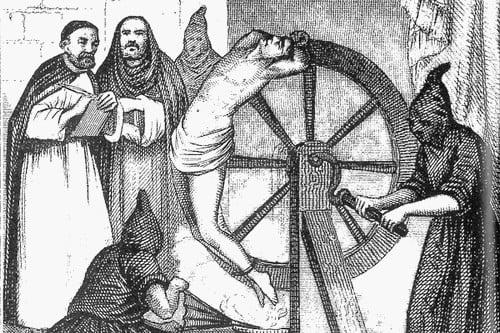
 Was a torture device used for capital punishment from Antiquity into early modern times for public execution by breaking the criminal's bones/bludgeoning him to death. As a form of execution, it was used from "Classical" times into the 18th century; as a form of post mortem punishment of the criminal, the wheel was still in use into 19th century Germany.The breaking wheel, also known as the Catherine wheel or simply the wheel, was a torture device used for capital punishment from antiquity into early modern times for public execution by breaking the criminal's bones/bludgeoning him to death. As a form of execution, it was used from classical times into the 18th century; as a form of post mortem punishment of the criminal, the wheel was still in use in 19th-century Germany.The wheel was typically a large wooden wagon wheel with many radial spokes. The condemned were lashed to the wheel and their limbs were beaten with a club or iron cudgel, with the gaps in the wheel allowing the limbs to give way and break.In France, the condemned were placed on a cartwheel with their limbs stretched out along the spokes over two sturdy wooden beams. The wheel was made to revolve slowly, and a large hammer or an iron bar was then applied to the limb over the gap between the beams, breaking the bones. This process was repeated several times per limb. Sometimes it was "mercifully" ordered that the executioner should strike the condemned on the chest and abdomen, blows known as coups de grâce (French: "blows of mercy"), which caused fatal injuries. Without those, the broken man could last hours and even days, during which birds could peck at the helpless victim. Eventually, shock and dehydration caused death. In France, a special grace, the retentum, could be granted, by which the condemned was strangled after the second or third blow, or in special cases, even before the breaking began.
Thursday, 21 January 2016
BREAKING WHEEL/ CATHERINE WHEEL
Was a torture device used for capital punishment from Antiquity into early modern times for public execution by breaking the criminal's bones/bludgeoning him to death. As a form of execution, it was used from "Classical" times into the 18th century; as a form of post mortem punishment of the criminal, the wheel was still in use into 19th century Germany.The breaking wheel, also known as the Catherine wheel or simply the wheel, was a torture device used for capital punishment from antiquity into early modern times for public execution by breaking the criminal's bones/bludgeoning him to death. As a form of execution, it was used from classical times into the 18th century; as a form of post mortem punishment of the criminal, the wheel was still in use in 19th-century Germany.The wheel was typically a large wooden wagon wheel with many radial spokes. The condemned were lashed to the wheel and their limbs were beaten with a club or iron cudgel, with the gaps in the wheel allowing the limbs to give way and break.In France, the condemned were placed on a cartwheel with their limbs stretched out along the spokes over two sturdy wooden beams. The wheel was made to revolve slowly, and a large hammer or an iron bar was then applied to the limb over the gap between the beams, breaking the bones. This process was repeated several times per limb. Sometimes it was "mercifully" ordered that the executioner should strike the condemned on the chest and abdomen, blows known as coups de grâce (French: "blows of mercy"), which caused fatal injuries. Without those, the broken man could last hours and even days, during which birds could peck at the helpless victim. Eventually, shock and dehydration caused death. In France, a special grace, the retentum, could be granted, by which the condemned was strangled after the second or third blow, or in special cases, even before the breaking began.
JUDAS CRADLE
 The casualty would apparently be set in the waist bridle over the pyramid-formed seat, with the point embedded into their an*s or v*gin*, then gradually brought down by ropes. The subject is tormented by exceptional weight and extending of the opening, in the end succumbing to tears in muscle tissue that could turn septic and execute from contamination, or basically being speared.The Judas Cradle, also known as the Judas chair and The Guided Cradle, was a torture device. In Italian it is the culla di Giuda; in German the Judaswiege; and in French the la veille—"the wake" or "nightwatch" (because when certain muscles are contracted, the victim could not fall asleep).The victim would presumably be placed in the waist harness above the pyramid-shaped seat, with the point inserted into their anus or vagina, then very slowly lowered by ropes. The subject is tortured by intense pressure and stretching of the orifice, eventually succumbing to tears in muscle tissue that could turn septic and kill from infection, or simply being impaled.A similar device, known as a horse, is sometimes said to have been used in Prussia to discipline soldiers. This device was not designed to break the skin but instead cause damage to the genitals.
PEAR OF ANGUISH/CHOKE PEAR
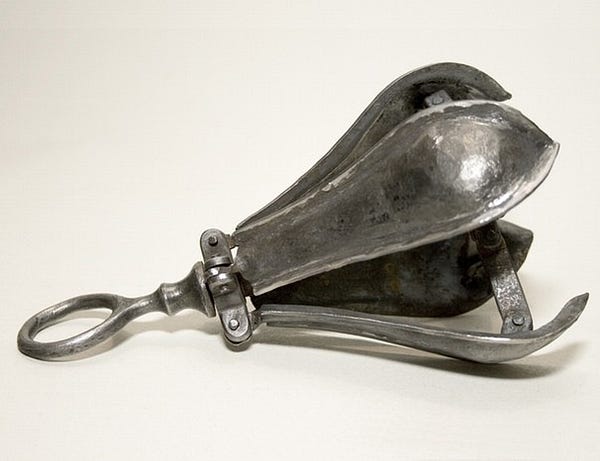 The pear of anguish or gag pear is the present day name for a kind of instrument showed in a few historical centers, comprising of a metal body (generally pear-molded) partitioned into spoon-like fragments that could be spread separated by turning a screw. The exhibition hall depictions and some late sources attest that the gadgets were utilized either as a stifler, to keep individuals from talking, or inside as an instrument of torment.The choke pear (or pear of anguish) is the modern name for a type of instrument displayed in some museums, consisting of a metal body (usually pear-shaped) divided into spoon-like segments that could be spread apart by turning a screw. The museum descriptions and some recent sources assert that the devices were used either as a gag, to prevent people from speaking, or internally as an instrument of torture.There is no contemporary first-hand account of these devices or their use. However, through the design of the devices, such as metal consistency and style, these are often dated to the early modern period (circa 1600). An early mention is in F. de Calvi's L'Inventaire général de l'histoire des larrons ("General inventory of the history of thieves"), written in 1639, which attributes the invention to a robber named Capitaine Gaucherou de Palioly in the days of Henry of Navarre. Palioly would have used a mechanical gag to subdue a wealthy Parisian while he and his accomplices robbed the victim's home.
WOODEN HORSE/SPANISH DONKEY
 One of the torment gadgets amid the Spanish Inquisition and medieval ages, this is presumably a standout amongst the most frightful of all of them. The casualty is put on the back of, stripped, on a jackass like device, which is really a vertical wooden board with a sharp V-wedge on top of it. After that, the torturer would add fluctuating weights to the casualty's feet until at long last the wedge cut through the casualty's body.The first variation of the wooden horse is a triangular device with one end of the triangle pointing upward, mounted on a saw-horse like support. The victim is made to straddle the triangular "horse." Weights or additional restraints were often added to keep the victim from falling off. A punishment similar to this called "riding the rail" was used during the American colonial period and later. The victim was often carried through town in this predicament, often in conjunction with the punishment of tarring and feathering. The crotch can be injured and the victim could be left unable to walk without pain.
While the device was designed for women, there are accounts of male victims as well. The Jesuit Relations say that in 1646, a man "was sentenced to make reparation, by the Civil authority, and to mount the Chevalet," and "a public blasphemer, was put on the Chevalet. He acknowledged his fault, saying that he had well deserved punishment, and came of his own accord to confess, that evening or the next day," and that another man "acted at the fort as such a glutton, that he was put on the Chevalet, on which he was ruptured.
STRAPPADO
 The Strappado is a type of torment in which the casualty's situation is anything but hopeful in the face of his or her good faith and suspended noticeable all around by method for a rope joined to wrists, which in all probability separates both arms. Weights may be added to the body to heighten the impact and expand the agony. Different names for strappado incorporate "converse hanging" and "Palestinian hanging" (despite the fact that it is not utilized by the Palestinian Authority) It is best known for its utilization in the dungeons of the medieval Inquisition.The Strappado is a form of torture in which the victim's hands are first tied behind his or her back and suspended in the air by means of a rope attached to wrists, which most likely dislocates both arms. Weights may be added to the body to intensify the effect and increase the pain.
It is not, as Samuel Johnson erroneously entered in his dictionary, a "chastisement by blows".There are three variants of this torture. In the first, the victim has his or her arms tied behind their back; a large rope is then tied to the wrists and passed over a pulley, beam, or a hook on the roof. The torturer pulls on this rope until the victim is hanging from the arms. Since the hands are tied behind the victim's back, this will cause a very intense pain and possible dislocation of the arms. The full weight of the subject's body is then supported by the extended and internally rotated shoulder sockets. While the technique shows no external injuries, it can cause long-term nerve, ligament, or tendon damage. The technique typically causes brachial plexus injury, leading to paralysis or loss of sensation in the arms.
BREAST RIPPER
 Known in another form as the Iron Spider or simply the spider, was a torture instrument mainly used on women who were accused of adultery, or self-abortion. The instrument was designed to rip the breasts from a woman and was made from iron, which was usually heated. The tool was used popularly in the Free State of Bavaria, a state in Germany, in 1599, and in parts of Germany and France until the nineteenth century.The Breast Ripper was first popularly used in Bavaria, Germany, in 1599. Until the early nineteenth century, the torture instrument was often used in Germany and France, in front of the victim's children. It was used on women for various reasons such as directing their own miscarriage, adultery, heresy, blasphemy, those who were accused of being witches, and for other crimes. It has also previously been used in interrogation.The Spider, also known as the Iron Spider, was a torture device similar to the Breast Ripper. The Iron Spider would have been attached to the wall, and the woman's breast were fixed onto the claws of the tool. The victim was then pulled away from the wall, removing her breasts.Another variant of this included spiked bars affixed slightly away from the wall. The victim would have been pulled along the bars until her breasts were removed.
HANGED, DRAWN AND QUARTERED
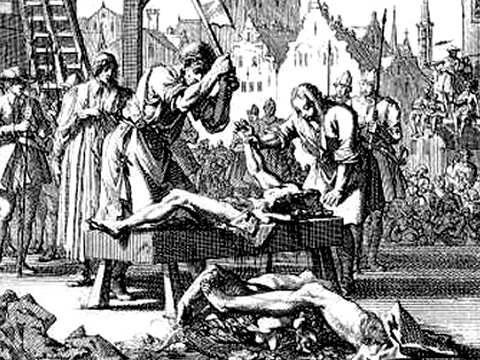 Amid medieval times, the punishment for high treachery in England was to be hanged, attracted and quartered open and however it was annulled in 1814, it has been in charge of the passing of a great many individuals. In this torment procedure, the casualty is dragged in a wooden edge called an obstacle to the spot of execution. They would then be hanged by the neck for a brief timeframe until they are close passing (hanged), trailed by gutting and maiming where the guts and genitalia are smoldered before the casualty (drawn). The casualty would then be isolated into four separate parts and decapitated (quartered).To be hanged, drawn and quartered was from 1351 a statutory penalty in England for men convicted of high treason, although the ritual was first recorded during the reign of King Henry III (1216–1272). Convicts were fastened to a hurdle, or wooden panel, and drawn by horse to the place of execution, where they were hanged (almost to the point of death), emasculated, disembowelled, beheaded and quartered (chopped into four pieces). Their remains were often displayed in prominent places across the country, such as London Bridge. For reasons of public decency, women convicted of high treason were instead burned at the stake.
The severity of the sentence was measured against the seriousness of the crime. As an attack on the monarch's authority, high treason was considered a deplorable act demanding the most extreme form of punishment; although some convicts had their sentences modified and suffered a less ignominious end, over a period of several hundred years many men found guilty of high treason were subjected to the law's ultimate sanction. They included many English Catholic priests executed during the Elizabethan era, and several of the regicides involved in the 1649 execution of Charles I.
Although the Act of Parliament defining high treason remains on the United Kingdom's statute books, during a long period of 19th-century legal reform the sentence of hanging, drawing and quartering was changed to drawing, hanging until dead, and posthumous beheading and quartering, before being abolished in England in 1870. The death penalty for treason was abolished in
BOOT
 The term boot alludes to a group of instruments of torment and cross examination differently intended to bring about squashing wounds to the foot and/or leg. The boot has taken numerous structures in different places and times. Regular assortments incorporate the Spanish boot and the Malay boot. One sort was made of four bits of tight wooden board nailed together. The sheets were measured to fit the casualty's leg. Once the leg was encased, wedges would be pounded between the sheets, making weight. The weight would be expanded until the casualty admitted or lost cognizance. More up to date variations have included iron vises,sometimes furnished with spikes that crushed feet and metal casings utilized super hot.
THE BRAZEN BULL
 Otherwise called the Sicilian Bull, it was composed in antiquated Greece. A strong bit of metal was cast with an entryway as an afterthought that could be opened and hooked. The casualty would be set inside the bull and a flame set underneath it until the metal turned out to be truly yellow as it was warmed. The casualty would then be gradually cooked to death all while shouting in horrifying torment. The bull was intentionally intended to open up these shouts and make them sound like the howling of a bull.The brazen bull, bronze bull, or Sicilian bull, was a torture and execution device designed in ancient Greece. According to Diodorus Siculus, recounting the story in Bibliotheca historica, Perillos of Athens invented and proposed it to Phalaris, the tyrant of Akragas, Sicily, as a new means of executing criminals. The bull was made entirely of bronze, hollow, with a door in one side. The bull was in the form and size of an actual bull and had an acoustic apparatus that converted screams into the sound of a bull. The condemned were locked in the device, and a fire was set under it, heating the metal until the person inside roasted to death.Phalaris commanded that the bull be designed in such a way that its smoke rose in spicy clouds of incense.[citation needed] The head of the bull was designed with a complex system of tubes and stops so that the prisoner's screams were converted into sounds like the bellowing of an infuriated bull. According to legend, when the bull was reopened, the victim's scorched bones "shone like jewels and were made into bracelets.
IRON MAIDEN
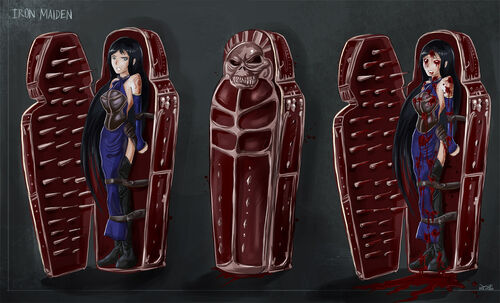 This torment gadget comprised of an iron bureau with a pivoted front and spike-secured inside, sufficiently adequate to encase a person. Once inside its cone shaped edge, the casualty would be not able move because of the colossal number of steel spikes piercing them from each heading. The examiner would shout questions at the casualty while jabbing them with spiked edges.Iron Maiden are an English heavy metal band formed in Leyton, east London, in 1975 by bassist and primary songwriter Steve Harris. The band's discography has grown to thirty-eight albums, including sixteen studio albums, eleven live albums, four EPs, and seven compilations.
Pioneers of the New Wave of British Heavy Metal, Iron Maiden achieved initial success during the early 1980s. After several line-up changes, the band went on to release a series of UK and US platinum and gold albums, including 1982's The Number of the Beast, 1983's Piece of Mind, 1984's Powerslave, 1985's live release Live After Death, 1986's Somewhere in Time and 1988's Seventh Son of a Seventh Son. Since the return of lead vocalist Bruce Dickinson and guitarist Adrian Smith in 1999, the band have undergone a resurgence in popularity,[2] with their 2010 studio offering, The Final Frontier, peaking at No. 1 in 28 different countries and receiving widespread critical acclaim. Their sixteenth studio album, The Book of Souls, was released on 4 September 2015.
TONGUE TEARER
BREAST RIPPER
Known in another form as the Iron Spider or simply the spider, was a torture instrument mainly used on women who were accused of adultery, or self-abortion. The instrument was designed to rip the breasts from a woman and was made from iron, which was usually heated. The tool was used popularly in the Free State of Bavaria, a state in Germany, in 1599, and in parts of Germany and France until the nineteenth century.The Breast Ripper was often used heated during torture and it contained four claws, which were used to slowly rip the breasts from women for various crimes.The instrument would be imposed onto a single breast of the woman. They were designed to shred, or tear off the breasts of the victim. If the woman did not die, she would be horribly disfigured for the rest of her lifeWednesday, 20 January 2016
THE RACK
 Is a torment gadget comprising of a rectangular, normally wooden edge, marginally raised starting from the earliest stage, a roller at one or both closures. The casualty's lower legs are secured to one roller and the wrists are binded to the next. As the cross examination advances, a handle and ratchet system connected to the top roller are utilized to bit by bit build the strain on the chains, instigating agonizing torment. By method for pulleys and levers this roller could be pivoted all alone hub, therefore straining the ropes until the sufferer's joints were disengaged and in the end isolated. Furthermore, if muscle are extended too much, they lose their capacity to contract, rendering them incapable. One abhorrent part of being extended too far on the rack is the noisy snapping so as to pop clamors made ligament, ligaments or bones.The rack is a torture device consisting of a rectangular, usually wooden frame, slightly raised from the ground, with a roller at one or both ends. The victim's ankles are fastened to one roller and the wrists are chained to the other. As the interrogation progresses, a handle and ratchet mechanism attached to the top roller are used to very gradually increase the tension on the chains, inducing excruciating pain. By means of pulleys and levers this roller could be rotated on its own axis, thus straining the ropes until the sufferer's joints were dislocated and eventually separated. Additionally, if muscle fibres are stretched excessively, they lose their ability to contract, rendering them ineffective.
One gruesome aspect of being stretched too far on the rack is the loud popping noises made by snapping cartilage, ligaments or bones. One powerful method for putting pressure upon prisoners was to force them to watch someone else being subjected to the rack. Confining the prisoner on the rack enabled further tortures to be simultaneously applied, typically including burning the flanks with hot torches or candles or using pincers made with specially roughened grips to tear out the nails of the fingers and toes. Usually, the victim's shoulders and hips would be separated and their elbows, knees, wrists, and ankles would be dislocated.
THE CHAIR OF TORTURE
 Otherwise called the Judas Chair, it was an unpleasant, threatening torment gadget that was added to prisons in the Middle Ages. Utilized until the 1800′s as a part of Europe, this seat was layered with 500 to 1,500 spikes on each surface with tight straps to control its casualty. Made of iron, it can likewise contain spaces for warming components underneath the seat. It was regularly used to alarm individuals into giving admissions as they watched others being tormented on the gadgeThere are many variants of the chair. They all have one thing in common: spikes cover the back, arm-rests, seat, leg-rests and foot-rests. The number of spikes in one of these chairs ranges from 500 to 1,500.
To avoid movement, the victim's wrists were tied to the chair or, in one version, two bars pushed the arms against arm-rests for the spikes to penetrate the flesh even further. In some versions, there were holes under the chair's bottom where the torturer placed coal to cause severe burns while the victim still remained conscious.
This instrument's strength lies primarily in the psychological fear caused on the victims. It was a common practice to extract a confession by forcing the victim to watch someone else be tortured with this instrument.
The time of death greatly varied ranging from a few hours to a day or more. No spike penetrated any vital organ and the wound was closed by the spike itself which delayed blood loss greatly.
SAW TORTURE
 In this strategy, the casualty is hung upside down, so that the blood will hurry to their heads and keep them cognizant amid the long torment. The torturer would then saw through the casualties' bodies until they were totally sawed down the middle. Most were cut up just in their midriff to drag out their anguish.The Saw was widely used throughout the Middle Ages, mainly because the tools required were found in most houses and no complex devices were required. It was a cheap way to torture and kill a victim who was often accused of: witchery, adultery, murder, blasphemy or even theft.
The victim was tied to an inverted position. This had several "benefits": first, it assured sufficient blood diverted to the brain, second, it slowed down the loss of blood and third, it humiliated the victim.
Depending on the victim and torturer, this torture could last several hours. When a confession was required, the victim was frequently forced to watch someone else be subject to this method. If he didn't confess, he'd be slowly cut in half.
During the Inquisition, this method became even more popular as the inquisitors traveled from village to village often without any torture devices at their disposal.
While some victims were cut completely in half as a symbolical gesture, most had only up to their abdomen cut, this was done to prolongue the time of death.
Subscribe to:
Comments (Atom)